
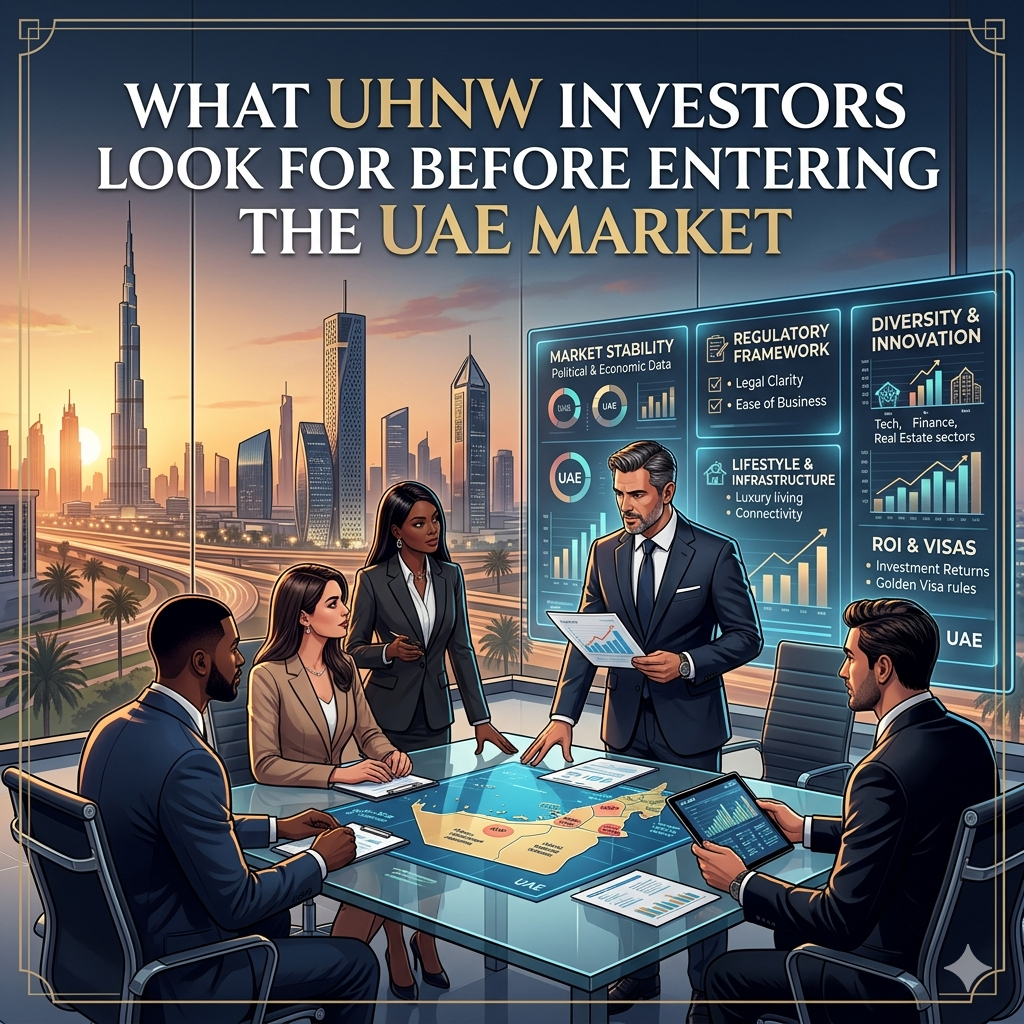
why access alone is never enough
Ultra-high-net-worth investors do not enter new markets casually.
They assess, structure, and align before capital moves.
In the United Arab Emirates, this approach becomes even more critical—because the market rewards precision, not speed.
For UHNW investors, the question is not “Is there opportunity?”
It is:
“Is the system aligned to support long-term capital?”
1. Jurisdictional clarity before opportunity
The first layer of evaluation is not the asset.
It is the jurisdiction itself.
UHNW investors assess:
- Legal framework stability
- Regulatory consistency
- Investor protection mechanisms
- Long-term policy direction
The UAE stands out because it offers clarity and predictability—but only when properly understood.
Without that understanding, even strong opportunities can become inefficient.
2. Banking access and credibility
Before deploying capital, UHNW investors prioritize banking.
They want to know:
- Which institutions will support their profile
- How funds will be transferred and managed
- What level of scrutiny to expect
- How relationships can scale over time
In the UAE, banking is not guaranteed.
It is earned through structure, transparency, and alignment.
Access to the right banking relationships is often more valuable than the investment itself.

3. Ownership structure and control
UHNW investors rarely hold assets directly without structure.
They evaluate:
- Entity formation (mainland vs free zone vs offshore)
- Ownership layering
- Risk isolation
- Flexibility for future transactions
The goal is not just ownership.
It is control with optionality.
A well-designed structure allows capital to move, adapt, and exit efficiently.
4. Tax positioning across jurisdictions
The UAE is known for tax efficiency.
But UHNW investors think globally.
They assess:
- Home country tax exposure
- Double taxation agreements
- Reporting obligations
- Exit and repatriation implications
Residency alone does not solve tax complexity.
It must be integrated into a multi-jurisdictional strategy.
5. Residency as a strategic anchor
Programs like the UAE Golden Visa are evaluated not as benefits—but as tools.
UHNW investors consider:
- Stability of residency over time
- Impact on banking relationships
- Family inclusion and continuity
- Mobility and travel flexibility
Residency strengthens the overall structure when aligned correctly.
6. Quality of opportunities—not quantity
Access to deals is not a differentiator.
UHNW investors are not impressed by:
- Volume of opportunities
- “Exclusive” deal labels
- Aggressive projections
They focus on:
- Pricing integrity
- Underlying demand
- Liquidity and exit potential
- Risk-adjusted returns
They are not looking for more deals.
They are looking for fewer, better decisions.

7. Execution environment
Even with strong planning, execution matters.
Investors evaluate:
- Ease of transactions
- Legal process efficiency
- Reliability of counterparties
- Speed with accuracy
Dubai performs well here—but only when the structure behind the transaction is correct.
8. Long-term alignment, not short-term gain
Perhaps the most defining trait:
UHNW investors optimize for:
- Capital preservation
- Multi-generational planning
- Strategic positioning
They are not entering the UAE for quick returns.
They are entering for long-term alignment with a stable system.
A different level of thinking
Retail investors ask:
“What should I buy?”
UHNW investors ask:
“How should I be positioned before I buy anything?”
That shift changes everything.
Final perspective
The UAE offers exceptional opportunities.
But UHNW investors do not start with opportunity.
They start with:
- Structure
- Banking
- Residency
- Tax alignment
Only then does capital move.
Because in markets like the United Arab Emirates, success is not determined by access.
It is determined by how well the system is designed before entry.
discreet advisory note
MU Private Office advises a limited number of UHNW investors entering the United Arab Emirates, aligning banking, residency, and ownership structures before capital is deployed—ensuring decisions are made within a coherent, long-term framework.