
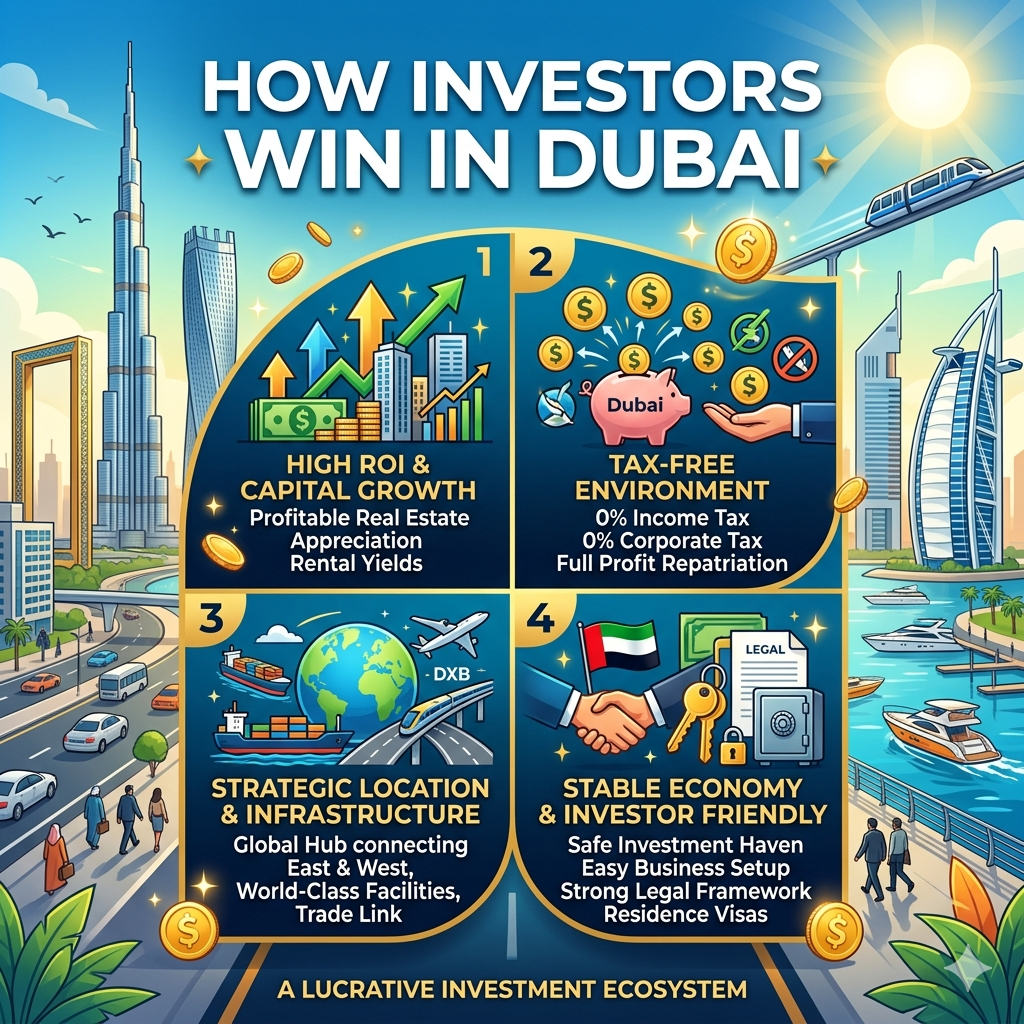
why success is rarely about timing—and almost always about structure
When people talk about winning in Dubai, the conversation usually focuses on timing.
Entering early.
Buying before the next price increase.
Catching the right cycle.
But serious investors understand something different:
Long-term success in Dubai is rarely determined by timing.
It is determined by structure, discipline, and precision.
The investors who consistently outperform are not necessarily faster.
They are simply better prepared.
1. They begin with strategy, not property
Most inexperienced investors ask:
“What should I buy?”
Successful investors ask:
“What framework should this investment sit inside?”
Before evaluating assets, they define:
- Investment objectives
- Time horizon
- Liquidity requirements
- Risk tolerance
Only then do they begin selecting opportunities.
This prevents emotional decision-making and ensures alignment.
2. They focus on pricing integrity
Winning investors understand that returns are often determined at purchase.
They evaluate:
- Recent comparable transactions
- Historical pricing movement
- Developer pricing discipline
- Real market support for valuation
They do not buy because a launch is popular.
They buy when pricing is supported by data.
In Dubai, the right entry price creates flexibility later.
3. They choose quality over noise
Strong investors ignore:
- Social media hype
- Aggressive launch campaigns
- Short-term market excitement
Instead, they focus on:
- Proven developers
- Real end-user demand
- Sustainable locations
- Asset durability over time
They understand that visibility does not equal value.

4. They structure before deploying capital
One of the clearest differences between average and sophisticated investors is preparation.
Winning investors align:
- Ownership structure
- Banking relationships
- Residency positioning
- Capital movement strategy
This ensures:
- Cleaner transactions
- Greater flexibility
- Stronger banking credibility
- Reduced long-term friction
In Dubai, structure is not an administrative detail.
It is a competitive advantage.
5. They think in liquidity, not just yield
High returns attract attention.
Liquidity protects capital.
Serious investors evaluate:
- Exit demand
- Buyer depth
- Financing accessibility for future purchasers
- Market resilience under pressure
A property with slightly lower yield but stronger liquidity often outperforms over time.
6. They understand Dubai as micro-markets
Successful investors never generalize.
They know that two projects just minutes apart can produce completely different outcomes.
They analyze:
- Tenant demand by location
- Supply pipeline pressure
- Infrastructure development
- Buyer profile trends
They treat Dubai as a network of distinct markets—not one unified trend.

7. They use uncertainty as leverage
When sentiment weakens, many investors hesitate.
Disciplined investors become more active.
They recognize that uncertainty often creates:
- Better pricing
- Greater seller flexibility
- Less speculative competition
They do not fear temporary inefficiencies.
They position through them.
8. They optimize for long-term coherence
Winning investors do not pursue isolated gains.
They build systems designed for:
- Scalability
- Capital preservation
- Multi-asset expansion
- Clean exits
Each decision supports the next.
This creates compounding advantages over time.
9. They move deliberately
Speed can be useful.
But only when preceded by clarity.
The most successful investors in Dubai are rarely impulsive.
They:
- Evaluate carefully
- Structure deliberately
- Execute confidently
Precision creates momentum.
A final perspective
Investors win in Dubai by understanding one simple truth:
The market rewards discipline more than enthusiasm.
Success comes from:
- Better preparation
- Better structure
- Better decision-making
Not from chasing momentum.
Same city.
Same market.
Different framework.
Different results.
discreet advisory note
MU Private Office works with a limited number of investors structuring and deploying capital in Dubai, aligning opportunity selection with banking, ownership, and long-term investment strategy.
→ Request consideration for a private investment strategy review