
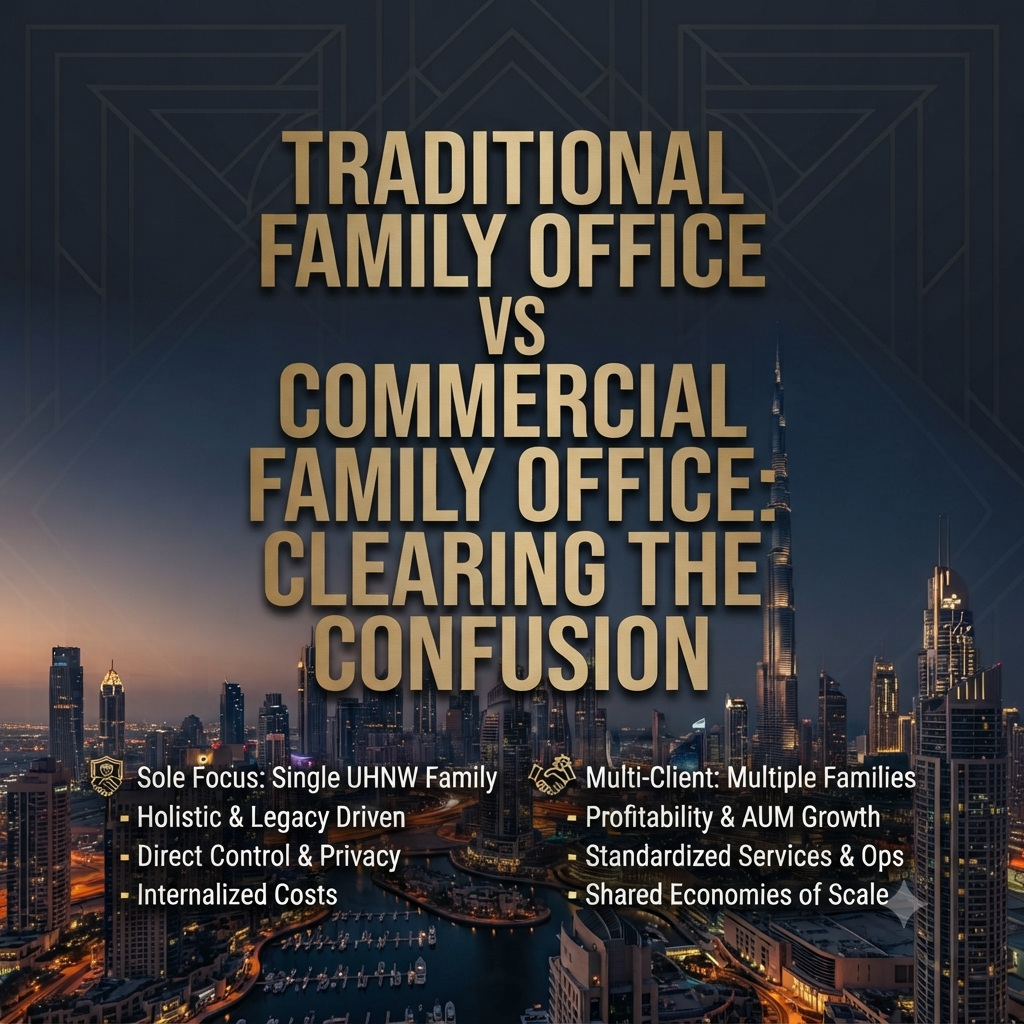
The term “family office” has become one of the most overused phrases in wealth management.
Today, many firms describe themselves as family offices.
Some provide investment advice.
Others sell financial products.
Some simply coordinate professional services.
The result is understandable confusion.
Because not every family office operates in the same way.
Understanding the difference between a traditional family office and a commercial family office is essential—particularly for families seeking long-term strategic support rather than transactional services.
What is a traditional family office?
A traditional family office is established to serve one family or a small number of related families.
Its purpose is not to generate revenue from multiple clients.
Its purpose is to protect, coordinate, and grow the interests of a single family’s wealth across generations.
A traditional family office may oversee:
- Investment management
- Real estate portfolios
- Operating businesses
- Banking relationships
- Tax coordination
- Succession planning
- Governance
- Philanthropy
- Lifestyle management
Its loyalty is exclusive.
Everything is designed around one family’s objectives.

What is a commercial family office?
A commercial family office applies many of the same principles—but serves a carefully selected group of external clients.
Rather than building infrastructure for one family, it provides access to strategic advisory, coordination, and oversight for entrepreneurs, investors, and internationally mobile families who require a similar level of support.
The emphasis is not on selling products.
It is on delivering integrated advice.
A commercial family office may assist with:
- Cross-border investment structuring
- Business establishment
- Private banking coordination
- Residency planning
- Real estate strategy
- Governance advisory
- Family office setup
- Long-term wealth positioning
The relationship is advisory-first rather than transaction-first.
The difference is not quality
Many assume a commercial family office is simply a smaller version of a traditional one.
That is not necessarily true.
The real distinction is who the office serves.
A traditional family office exists exclusively for one family’s interests.
A commercial family office provides that strategic thinking to a limited number of carefully selected clients.
The philosophy can be remarkably similar.
The client structure is different.

Why the distinction matters
Understanding this difference helps investors ask better questions.
Instead of asking:
“Do you call yourself a family office?”
Ask:
- Who do you represent?
- How are conflicts managed?
- Are recommendations product-driven or advisory-driven?
- Do you coordinate multiple aspects of wealth or only one?
- Is the relationship designed for transactions or long-term oversight?
These questions reveal far more than the title itself.
Advisory versus distribution
One of the defining characteristics of a genuine family office model is independence.
Its role is not simply to introduce opportunities.
It is to evaluate them.
That means asking questions such as:
- Does this investment fit the family’s objectives?
- How does it affect liquidity?
- Does it align with existing structures?
- What risks exist beyond the asset itself?
A family office should provide judgment before access.
Because opportunities without context rarely create better outcomes.
Coordination is becoming more valuable than execution
As wealth becomes increasingly international, families face greater complexity.
Real estate.
Businesses.
Private banking.
Residency.
Compliance.
Governance.
These decisions no longer operate independently.
The value of a family office increasingly lies in its ability to coordinate these moving parts into a single strategic framework.
Execution is important.
Coordination is indispensable.

Why more investors are choosing commercial family offices
Many successful entrepreneurs and investors have reached a point where they need more than individual specialists.
They need someone to connect the dots.
A commercial family office offers access to that level of strategic oversight without requiring the scale or expense of establishing a dedicated single-family office.
For many internationally active investors, this model provides the balance between institutional thinking and practical implementation.
Our perspective
At MU Private Office, we view a private office as an advisory platform—not a distribution platform.
Our role is not to promote products or transactions.
It is to help clients make better decisions by aligning:
- Business strategy
- Banking relationships
- Residency planning
- Real estate investments
- Cross-border structuring
- Long-term wealth objectives
We believe thoughtful coordination consistently outperforms fragmented advice.
Final perspective
The term “family office” is becoming increasingly common.
But the name alone tells you very little.
What matters is how the office thinks.
Does it prioritise long-term relationships over transactions?
Does it coordinate rather than simply execute?
Does it provide independent judgment before opportunities are pursued?
Ultimately, the best family offices—whether traditional or commercial—share the same objective:
To help families preserve, grow, and transition wealth with clarity, discipline, and long-term perspective.
discreet advisory note
MU Private Office works with a limited number of founders, investors, and internationally active families seeking integrated strategic advisory rather than transactional services. We accept engagements selectively where long-term alignment, discretion, and independent judgment are the foundation of the relationship.