
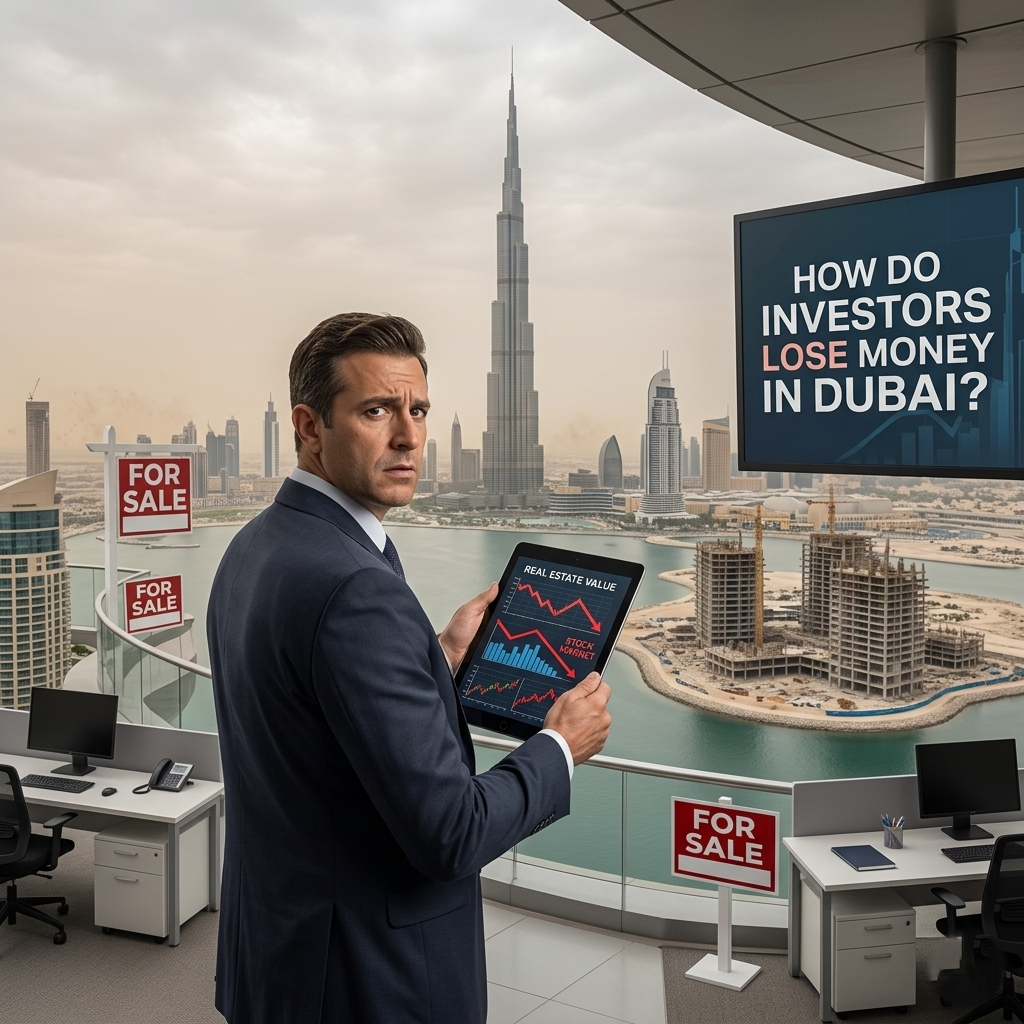
not by entering the market—but by how they enter it
Dubai is often described as a high-opportunity market.
Strong yields.
Tax efficiency.
Global demand.
All of that is true.
Yet investors still lose money in Dubai.
Not because the market is inherently risky—
but because the approach is often flawed from the beginning.
1. Buying based on marketing, not fundamentals
Dubai is one of the most effectively marketed real estate markets in the world.
Investors are often influenced by:
- Payment plans
- Project visuals
- “Limited units” narratives
- Social media momentum
What gets overlooked:
- Comparable transaction data
- Real rental demand
- Developer track record
- True market pricing
When decisions are driven by presentation instead of data,
overpaying becomes almost inevitable.
2. Entering at the wrong price
Even in a strong market, price matters.
Common mistakes:
- Buying off-plan above current resale benchmarks
- Assuming future appreciation will justify today’s premium
- Ignoring micro-market pricing differences
The result:
- Lower-than-expected returns
- Difficulty exiting at target price
- Compressed yield
In Dubai, entry price often determines outcome more than timing.
3. Ignoring liquidity and exit
Many investors focus only on:
- Purchase price
- Projected returns
Few consider:
- Who will buy this later?
- How easy is it to exit?
- Is financing available for future buyers?
Assets with weak exit demand create hidden risk.
An investment is only successful if it can be exited efficiently.

4. Misunderstanding yield
Headline yields can be misleading.
Investors often calculate:
Rent ÷ Purchase price = return
But ignore:
- Service charges
- Maintenance costs
- Vacancy periods
- Management fees
A property marketed at 8–9% can easily drop to 5–6% net.
Yield is not what is advertised.
It is what remains after reality.
5. Weak or misaligned structure
One of the most overlooked risks is structural.
Investors enter without aligning:
- Ownership structure
- Banking relationships
- Residency positioning
This leads to:
- Transaction delays
- Banking friction
- Compliance complications
- Limited flexibility
In many cases, losses don’t come from the asset.
They come from the framework around it.
6. Chasing short-term gains
Dubai attracts momentum-driven capital.
Investors try to:
- Flip off-plan units quickly
- Enter and exit within short cycles
- Time the market perfectly
This strategy depends on:
- Continuous demand
- Favorable sentiment
- Liquidity at the right moment
When sentiment shifts, these strategies fail first.

7. Underestimating supply pressure
Dubai builds continuously.
While this supports growth, it also creates:
- Competition within similar property types
- Pressure on pricing in oversupplied areas
- Reduced rental growth in certain segments
Not all areas absorb supply equally.
Ignoring this leads to:
- Slower appreciation
- Longer vacancy periods
- Weaker resale demand
8. Treating Dubai as a single market
Dubai is not one market.
It is a collection of micro-markets with:
- Different demand drivers
- Different tenant profiles
- Different pricing dynamics
Investors who generalize:
- Overestimate growth
- Misread risk
- Choose the wrong segment
Precision matters.
9. Moving too fast
Speed is one of the most common causes of loss.
Investors rush due to:
- Fear of missing out
- Limited-time offers
- Market hype
This leads to:
- Incomplete due diligence
- Poor asset selection
- Misaligned strategy
In Dubai, speed without structure creates exposure.
A final perspective
Investors do not lose money in Dubai because the market is broken.
They lose money because:
- They overpay
- They misunderstand risk
- They ignore structure
- They prioritize speed over clarity
The market rewards those who:
- Analyze deeply
- Structure correctly
- Enter deliberately
Same city.
Same opportunities.
Very different outcomes.
discreet advisory note
MU Private Office works with a limited number of investors entering Dubai, focusing on pricing integrity, structural alignment, and exit clarity before capital is deployed.
→ Request consideration for a private investment risk review