
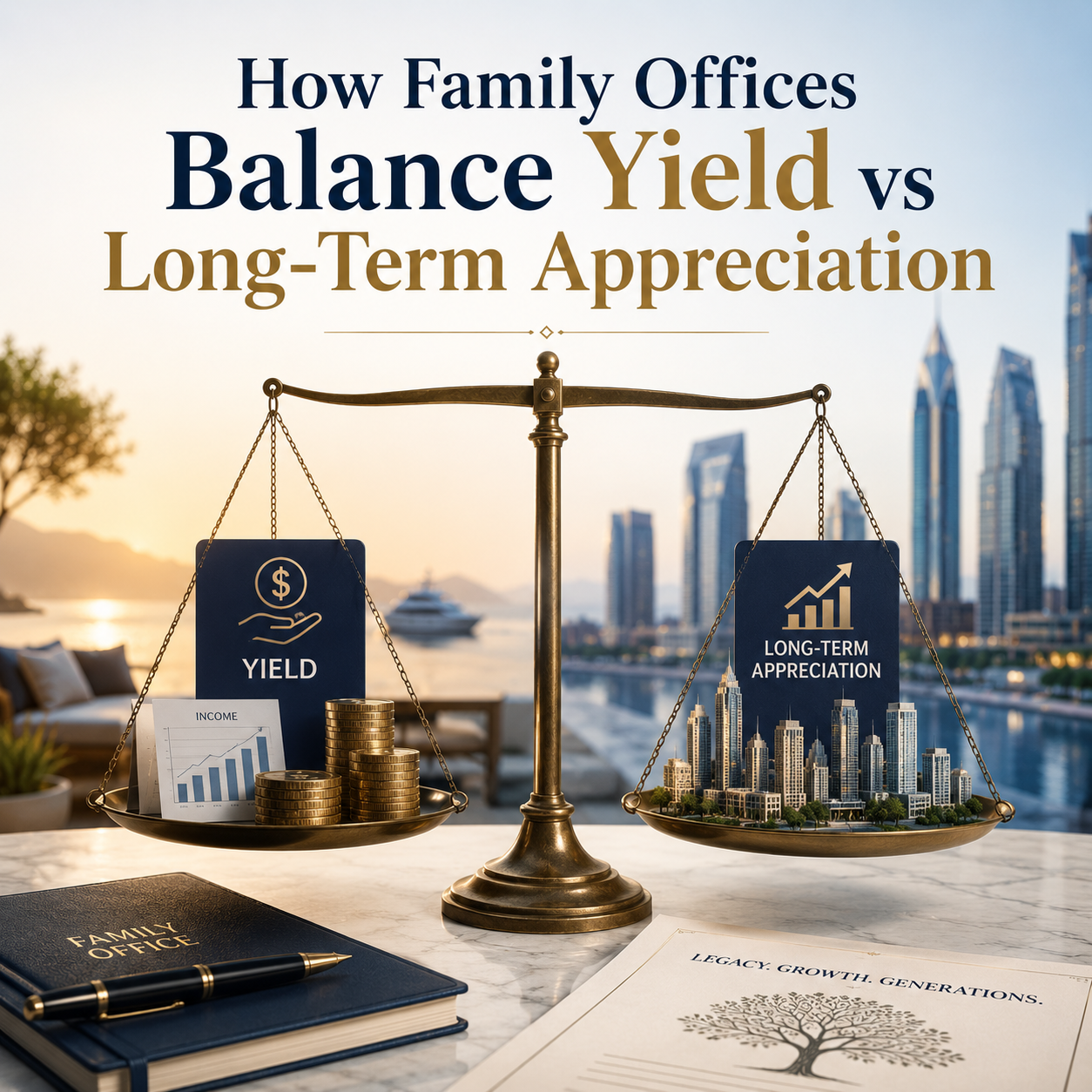
The tension between yield and appreciation is not a problem to be solved. It is a condition to be managed — and managed differently depending on which generation of wealth is making the decision.
First-generation family offices often tilt toward income. Their capital is still doing the work of consolidation. Later-generation structures, already built on a durable base, can afford to think in decades. The sophistication lies not in choosing one over the other, but in knowing precisely when and why the balance should shift.
What follows is a framework for that decision — not a formula, but a set of principles that serious family office capital applies in practice.
01 The framing question
The question is not which. It is when.
Most investment frameworks present yield and appreciation as competing strategies. They are not. They are sequential priorities — and the sequence is determined by the maturity of the family’s capital position, the liquidity demands of the current generation, and the time horizon of the structure holding the asset.
A family office in active wealth-building mode, with distribution requirements and governance costs to service, needs income that arrives predictably. A multigenerational trust with no immediate liquidity need can hold an asset for fifteen years without a single distribution — and likely should, if the appreciation thesis is sound.
The mistake is anchoring to a yield-versus-appreciation framework at all. The real framework is: what does this capital need to do right now, and what should it be positioned to do in ten years?
02 Allocation logic
How serious family offices actually allocate
Real estate allocations reached 39% of family office portfolios in 2025 — the highest in a decade. But the composition of that allocation is more revealing than the percentage. Disciplined family offices structure across four layers, each serving a distinct function in the overall capital architecture.
| Layer | Allocation | Primary objective | Return profile |
|---|---|---|---|
| Core | 40% | Stable income, capital preservation | 7–10% annually, low risk |
| Core-plus | 25% | Income + modest enhancement | 8–10%, moderate leverage |
| Value-add | 20% | Appreciation, repositioning | 11–15%, higher leverage |
| Opportunistic | 15% | Long-term compounding | 15%+, patient capital required |
This is not a rigid prescription. It is a logic. The core layer anchors the portfolio in predictable cashflow. The opportunistic layer captures asymmetric appreciation — but only when the rest of the structure can afford the patience that position requires.

03 The yield case
Why yield deserves more respect than it receives
Income-producing real estate is frequently treated as the conservative, unambitious allocation. This view is incomplete.
Reliable yield is capital efficiency. It means the asset is funding its own governance costs, contributing to family distributions, and reducing the need to liquidate at inconvenient moments. In Dubai specifically, mid-market residential assets averaging 6.7% to 8.5% gross yield — with net yields approaching 5.5% to 6.5% after costs — provide a return floor that no other global gateway city currently matches.
Yield also provides information. An asset that produces consistent rental income across economic cycles is demonstrating genuine demand — a signal of durable underlying value that price-per-square-foot figures alone cannot replicate.
Cash flow is not just income. It is evidence that the asset is worth what you paid for it.
04 The appreciation case
Appreciation is not passive. It is selected.
The expectation that Dubai property appreciates over time is not a thesis. It is a hope. The thesis requires specificity: which asset class, which community, which entry price relative to replacement cost, and which infrastructure catalysts are not yet priced in.
Yield compression — where rising capital values outpace rental growth — was the appreciation driver of the previous cycle. PwC’s analysis of the next real estate cycle is direct: that mechanism is no longer reliable. The next appreciation cycle will be driven by income growth and operational value creation, not passive holding in the path of capital flows.
For family offices, this means appreciation must be actively curated: emerging waterfront corridors before full infrastructure delivery, off-plan positions in master communities where completion will create a step-change in pricing, or sustainability-led assets as institutional capital applies ESG screens and bids up qualifying stock.
05 Liquidity architecture
Liquidity is not an afterthought. It is a strategy.
The defining challenge for family office real estate in 2026 is not finding return — it is managing the tension between liquidity and yield. Illiquid private real estate offers higher income potential but demands patience. Liquid vehicles offer optionality but compress returns.
The resolution is layering. Liquid assets — REITs, listed vehicles, high-grade short-duration fixed income — provide stability and optionality. Private real estate allocations generate income and long-term appreciation. Each layer serves a specific role. The failure mode is allowing the liquidity layer to shrink in pursuit of yield, then being forced to exit private positions at inopportune moments when unexpected liquidity requirements arise.
In practice: family offices holding 15% to 20% of the real estate portfolio in liquid or semi-liquid instruments have materially better outcomes across cycles than those fully concentrated in direct holdings.
06 Tax and structure
Structure shapes the effective return
The gross yield on a Dubai property and the net return to a family office in, say, Germany or India can be materially different numbers — not because of property performance, but because of ownership structure.
Depreciation treatment, whether distributions are classified as income or return of capital, the interaction between UAE zero-tax and home-jurisdiction tax treaty provisions, and the estate planning implications of direct versus indirect ownership all affect what the family actually receives. Family offices structured through DIFC entities or appropriately domiciled holding vehicles can significantly improve after-tax return without altering the underlying asset at all.
This is not tax avoidance. It is structuring — and it is where significant value is created or destroyed before a single rent cheque arrives.
07 Generational transfer
The third objective: transferability
Yield and appreciation are the two dimensions most family offices articulate. There is a third that sophisticated structures build toward from the beginning: transferability.
An asset that generates good yield and has appreciated significantly is a success story — until it needs to pass to the next generation and the ownership structure creates probate exposure, tax crystallisation events, or governance conflict between heirs. Real estate held in individual names, without a holding structure designed for succession, can erode a generation of compounding in a single transfer event.
The family offices that manage wealth across multiple generations are not those with the best-performing assets. They are those whose structures were designed to receive the assets with minimal friction at each generational transition.
The question at acquisition is not only: will this asset perform? It is: will this asset transfer cleanly when the time comes?
08 The Dubai context
Why Dubai resolves the tension better than most markets
The yield-versus-appreciation tension is most acute in markets where capital values have run ahead of rental income — where you must choose between a high-priced asset that appreciates and a lower-grade asset that yields. London and Singapore have occupied this position for years.
Dubai currently offers an unusual combination: mid-market assets yielding 6.7% to 8.5% gross in communities where infrastructure investment provides a credible appreciation thesis. This simultaneity — genuine income and genuine capital upside in the same asset — is structurally rare and is what continues to attract family office capital from across Asia, Europe, and the Middle East.
It will not persist indefinitely. As more capital recognises this combination, it will price it out. The window for acquiring yield-generating assets with a credible appreciation overlay in Dubai is narrowing — not because the market is cooling, but because it is maturing.
The family office that manages the yield-versus-appreciation tension well is not one that found the perfect balance. It is one that understood the balance was dynamic — shifting with the generation, the liquidity position, the tax environment, and the cycle.
Income that compounds without structural leakage, appreciation that is curated rather than assumed, and assets structured to transfer cleanly across generations — these are not three separate objectives. They are one coherent strategy, executed with discipline over time.
Dubai, at this moment in its cycle, remains one of the few markets where all three are achievable within the same portfolio. That is the case for being here. The case for how requires considerably more precision.
Private client advisory
MU Private Office works with a limited number of family offices, founders, and wealth principals each year — those navigating a real estate allocation strategy that intersects with residency, succession, and long-term capital structuring. Our work is advisory-led, structurally focused, and entirely private.
→ Request consideration for a private investment strategy review