
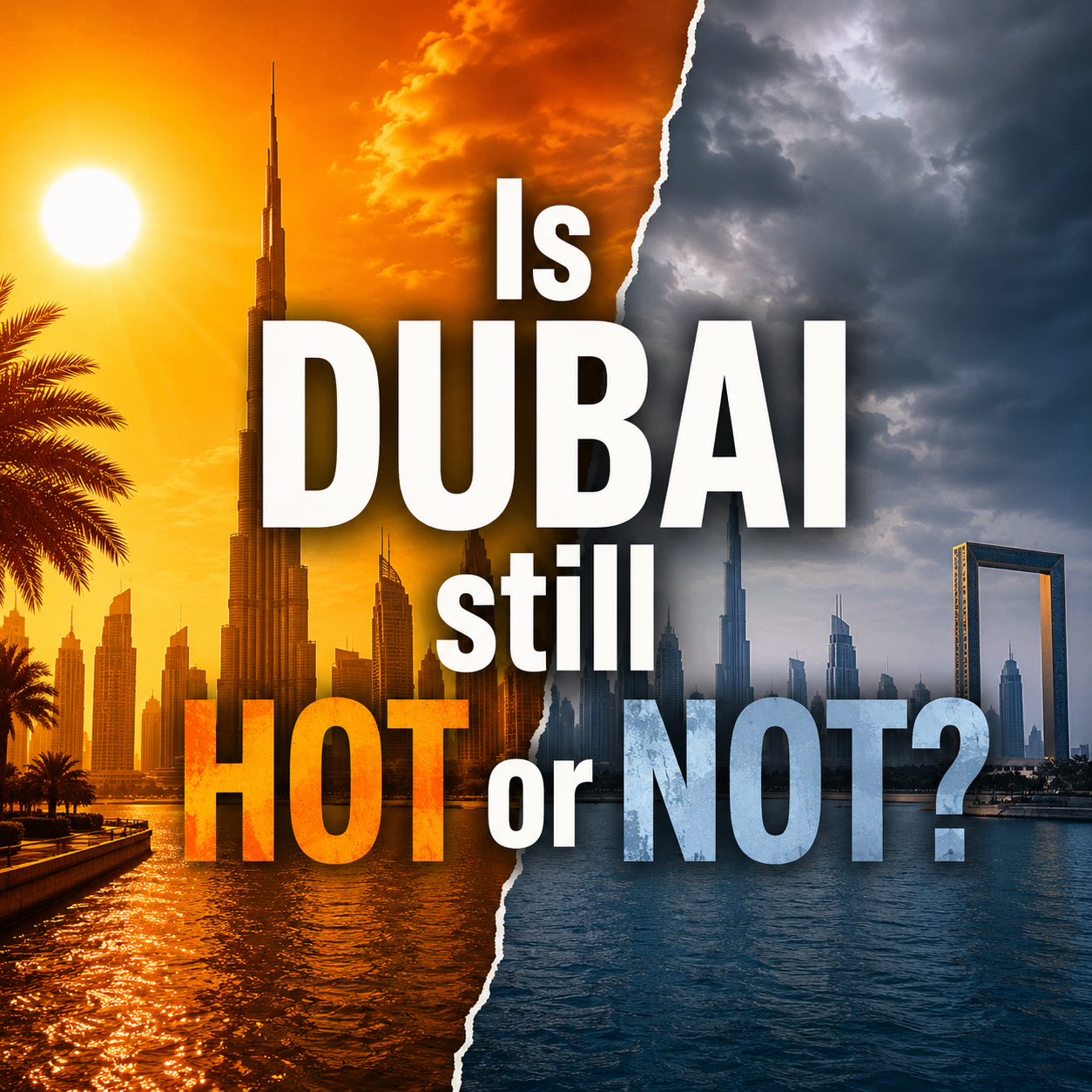
the market is changing—but that’s not the same as weakening
For the last few years, Dubai has been one of the most talked-about markets globally.
Prices surged.
Capital flowed in.
Luxury real estate accelerated.
Global entrepreneurs relocated.
Now the question investors are quietly asking is different:
Is Dubai still hot—or has the cycle peaked?
The answer depends entirely on how you define “hot.”
The easy-money phase is slowing
There is no question that the market today feels different from the aggressive momentum of the previous cycle.
- Buyers are becoming more selective
- Negotiations are increasing
- Certain secondary properties are softening
- Off-plan competition is rising
The days where almost every asset appreciated quickly are becoming less common.
That phase of the cycle is maturing.
But fundamentals remain unusually strong
What many people confuse is:
slower momentum ≠ weak market
Dubai still benefits from:
- Population growth
- Global wealth migration
- Strong rental demand
- Tax efficiency
- Infrastructure expansion
- Political and economic stability
These are not temporary drivers.
They are structural.
The market is becoming less forgiving
This is the real shift happening.
A few years ago:
- weak projects still performed
- average locations appreciated
- speculation often worked
Today:
- pricing matters more
- supply quality matters more
- liquidity matters more
- developer credibility matters more
Dubai is not becoming cold.
It is becoming more selective.
Prime assets are separating from average ones
One of the clearest signs of market maturity is fragmentation.
Strong assets continue attracting:
- international buyers
- end-users
- institutional capital
Meanwhile weaker projects are beginning to experience:
- slower absorption
- pricing pressure
- lower resale demand
This is what healthy markets eventually do.
They stop rewarding everything equally.
Sentiment is shifting faster than fundamentals
Much of today’s uncertainty is psychological.
Investors see:
- geopolitical tension
- rising global rates
- supply pipeline discussions
And sentiment reacts immediately.
But fundamentals move slower than emotion.
Dubai’s underlying demand drivers have not disappeared simply because investor psychology has become cautious.
“Hot” markets attract the wrong behavior
Ironically, the periods when markets feel hottest are often the most dangerous.
That is when:
- discipline disappears
- overpaying becomes normalized
- speculation replaces analysis
More measured conditions often create better investing environments.
Because:
- pricing becomes more rational
- sellers become flexible
- competition reduces
- quality matters again
Dubai is moving from momentum to maturity
This may be the most important shift of all.
Dubai is transitioning from:
- rapid-growth perception
to - long-term institutional relevance
That means the market increasingly rewards:
- structure
- patience
- asset quality
- strategic positioning
instead of pure speed.
So… is Dubai still hot?
If by “hot” people mean:
- easy flips
- universal price surges
- speculation everywhere
Then no—the market is evolving beyond that.
But if “hot” means:
- global capital inflows
- strong long-term fundamentals
- wealth migration
- strategic relevance
- investor demand
Then Dubai remains one of the strongest markets globally.
Just more selective than before.
Final perspective
The smartest investors are no longer asking:
“Is Dubai hot?”
They are asking:
“Which parts of Dubai still make strategic sense?”
That is a far more sophisticated question.
Because markets mature.
And mature markets reward discipline—not excitement.
discreet advisory note
MU Private Office works selectively with investors evaluating strategic positioning in Dubai, focusing on asset quality, market timing, and long-term structural alignment rather than short-term market sentiment.
→ Request consideration for a private market positioning review