
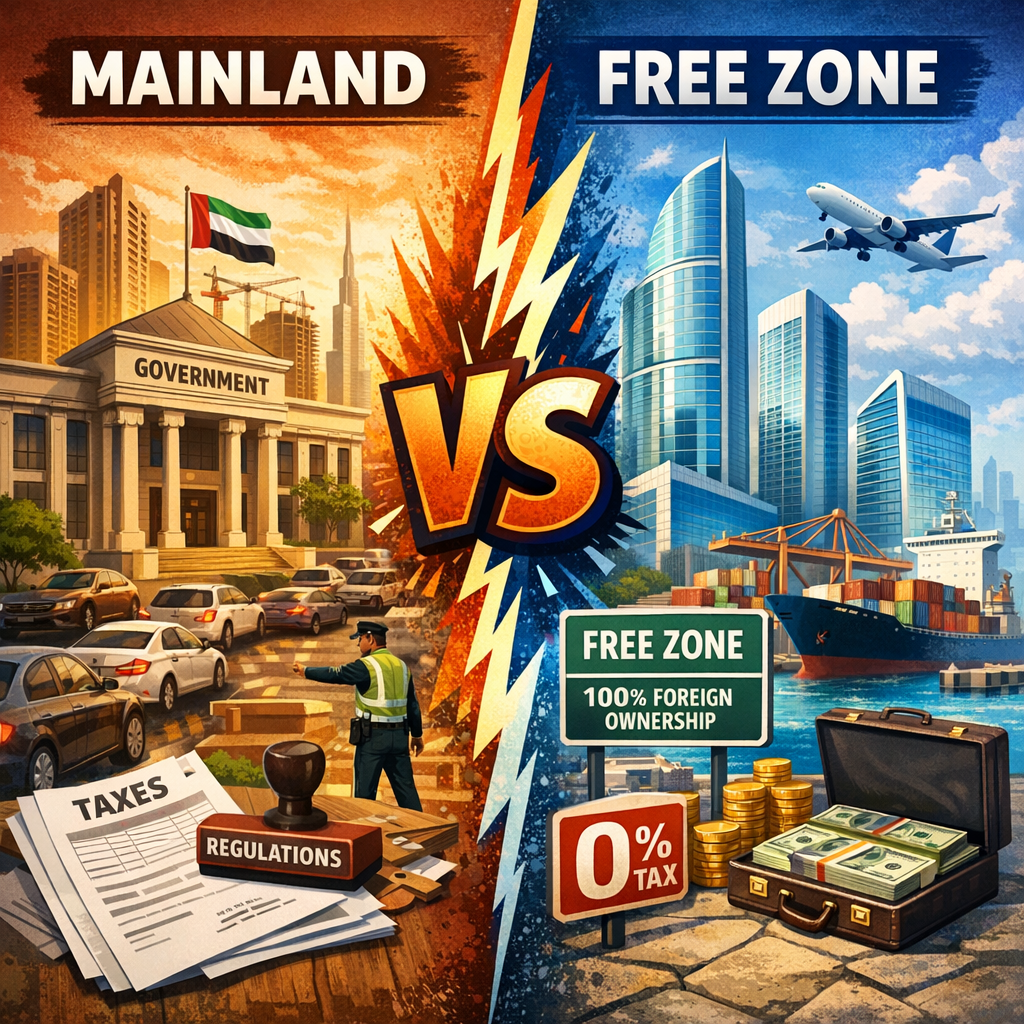
For years, foreign investors entering United Arab Emirates had to structure carefully around ownership restrictions.
Today, the landscape has changed.
100% foreign ownership is now possible—but not in every situation, and not without nuance.
The real question is no longer “Can I own 100%?”
It is:
“Where should I own 100%—and why?”
The shift: what changed?
Historically:
- Mainland companies required a local Emirati partner (51%)
- Free zones allowed 100% foreign ownership
Now:
- Most mainland activities allow 100% foreign ownership
- Free zones continue to offer 100% ownership by default
This reform has simplified entry—but also created new strategic decisions.
What “100% ownership” actually means
Ownership is often misunderstood.
It does not only refer to shares.
It affects:
- Control over operations
- Profit distribution
- Decision-making authority
- Exit flexibility
Two structures may both offer 100% ownership—but behave very differently in practice.
Free Zone: full ownership, controlled scope
Free zones across Dubai and the wider UAE are designed for simplicity and speed.
Key characteristics:
- 100% foreign ownership (standard)
- Fast setup processes
- Lower initial costs (in many cases)
- Business activities restricted to:
- Within the free zone
- International markets
Limitations:
- Direct trading in the UAE mainland is restricted
- Banking can be more selective depending on activity
- Some structures are less flexible for scaling
Best suited for:
- International businesses
- Consultants and service providers
- Digital and remote-first companies
Mainland: full ownership with full market access
Mainland companies are licensed under the UAE’s central regulatory framework.
Key characteristics:
- 100% foreign ownership (for most activities)
- Ability to operate anywhere in the UAE
- No restriction on local market access
- Greater flexibility for growth and expansion
Considerations:
- Higher setup and operational costs
- More complex compliance requirements
- Licensing must align precisely with business activity
Best suited for:
- Businesses targeting the UAE market
- Retail, trading, and physical operations
- Companies planning to scale locally
The critical difference: access vs flexibility
At a surface level, both options offer 100% ownership.
But strategically:
- Free zone = ownership + simplicity + limited access
- Mainland = ownership + access + higher responsibility
Choosing between them is not about ownership percentage.
It is about how and where the business needs to operate.
Where investors make mistakes
The most common errors include:
1. Choosing based on cost
Low-cost free zone setups often create:
- Banking difficulties
- Activity limitations
- Future restructuring costs
2. Ignoring banking realities
Certain jurisdictions and activities face:
- Higher compliance scrutiny
- Slower account approvals
3. Misaligned licensing
If your activity does not match your license:
- You risk operational restrictions
- Or compliance issues later
4. Thinking short-term
What works at setup may not work at scale.
Restructuring later is always more expensive.

When 100% ownership is not enough
Ownership alone does not guarantee control or success.
What matters is alignment between:
- Business model
- Jurisdiction
- Banking strategy
- Regulatory requirements
Without alignment, even a 100% owned structure can become inefficient.
A final perspective
The UAE has made ownership simpler.
But decision-making has become more complex.
Because now, investors are not constrained by rules.
They are defined by their choices.
Choosing between mainland and free zone is not a legal decision.
It is a strategic one.
discreet advisory note
MU Private Office advises a limited number of founders and investors structuring entities in United Arab Emirates, ensuring ownership, licensing, and banking frameworks are aligned before operations begin.