
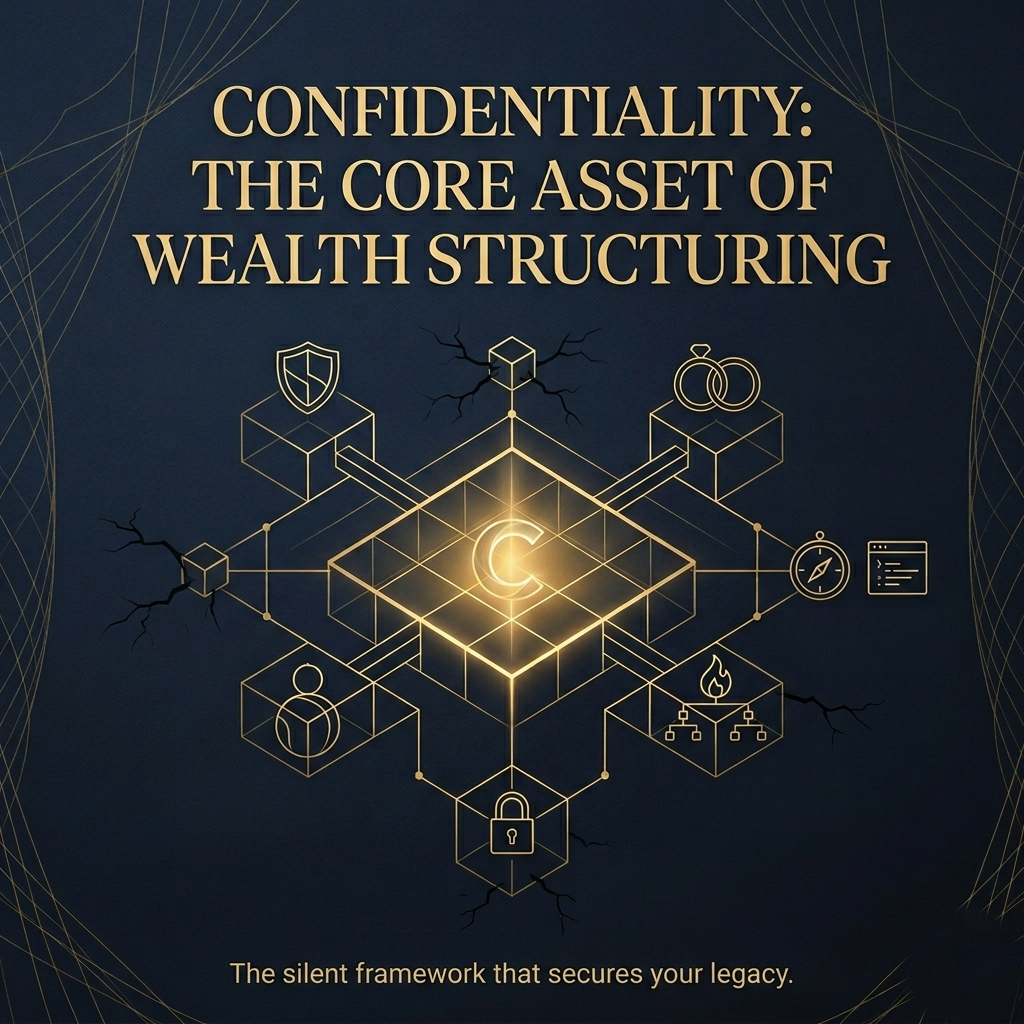
Because exposure creates risk long before loss appears
Most people think wealth structuring is about:
- tax efficiency
- legal entities
- investment performance
But sophisticated families understand something deeper:
Confidentiality itself is an asset.
Not secrecy for the sake of secrecy.
But controlled visibility, disciplined information flow, and protection from unnecessary exposure.
In modern wealth structuring, confidentiality is no longer optional.
It is infrastructure.
1. Visibility changes risk
As wealth becomes more visible, risk changes shape.
Exposure can create:
- unwanted attention
- reputational vulnerability
- legal scrutiny
- security concerns
- opportunistic counterparties
Often, these risks emerge long before any financial loss occurs.
Sophisticated families therefore focus not only on protecting capital—
but on protecting the information surrounding it.
2. Confidentiality protects strategic flexibility
Public visibility limits optionality.
When structures, transactions, or ownership positions become overly exposed:
- negotiations become harder
- pricing dynamics shift
- counterparties behave differently
- strategic movement becomes restricted
Confidentiality preserves flexibility.
It allows families and principals to:
- reposition quietly
- restructure efficiently
- allocate capital without signaling intentions prematurely
In wealth structuring, silence often creates leverage.

3. Fragmented advisory relationships increase exposure
One of the most overlooked risks in wealth management is fragmentation.
Different advisors handling:
- banking
- legal matters
- residency
- investments
- tax structuring
without coordination often create uncontrolled information flow.
This leads to:
- duplicated exposure
- inconsistent reporting
- operational leakage
- unnecessary visibility across systems
Confidentiality requires coordination—not just discretion.
4. Modern wealth is increasingly digital
Today, exposure is no longer only physical or institutional.
It is digital.
Data now exists across:
- banking systems
- compliance frameworks
- communication platforms
- global reporting structures
This changes the nature of wealth protection entirely.
Sophisticated structuring now includes:
- controlled data access
- limited visibility frameworks
- operational compartmentalization
- selective disclosure discipline
The challenge is no longer hiding wealth.
It is managing how information moves around it.

5. Confidentiality is not about avoiding compliance
A critical distinction:
Serious confidentiality is fully compliant.
Sophisticated families are not trying to avoid:
- regulation
- reporting obligations
- legal transparency requirements
Instead, they aim to avoid unnecessary exposure beyond what is legally required.
There is a difference between:
- transparency to institutions
and - visibility to the broader market
Mature structuring respects both compliance and discretion simultaneously.
6. The more global the family. the more global the family, the more important confidentiality becomes
Globally mobile families often operate across:
- multiple jurisdictions
- multiple banking systems
- multiple operating structures
Without disciplined confidentiality protocols:
- information becomes fragmented
- counterparties gain incomplete context
- operational risk increases
As structures scale internationally, confidentiality becomes operational—not cosmetic.

7. Quiet structures often outperform loud ones
There is a reason many sophisticated families avoid excessive visibility.
Quiet structures tend to:
- reduce friction
- improve negotiation positioning
- preserve long-term flexibility
- lower reputational exposure
In many cases, the strongest wealth structures are intentionally unremarkable from the outside.
That is not weakness.
It is design.
8. Confidentiality builds trust internally as well
Confidentiality is not only external.
Within family systems, it also supports:
- governance clarity
- controlled decision-making
- operational discipline
- generational continuity
Poor information governance creates confusion internally just as easily as externally.
Strong private offices understand this deeply.
Final perspective
Wealth structuring is often discussed in terms of growth.
But sophisticated families increasingly think in terms of:
- resilience
- control
- continuity
- protection
And confidentiality sits at the center of all four.
Because in a world of increasing visibility,
the ability to remain strategically private becomes extraordinarily valuable.
Not everything valuable should be visible.
discreet advisory note
MU Private Office advises a limited number of families and principals structuring cross-border wealth frameworks with a strong emphasis on confidentiality, operational coordination, and long-term capital protection.